Welcome back!
Ready to check out?
You're just one click away from fantastic style and even better savings!
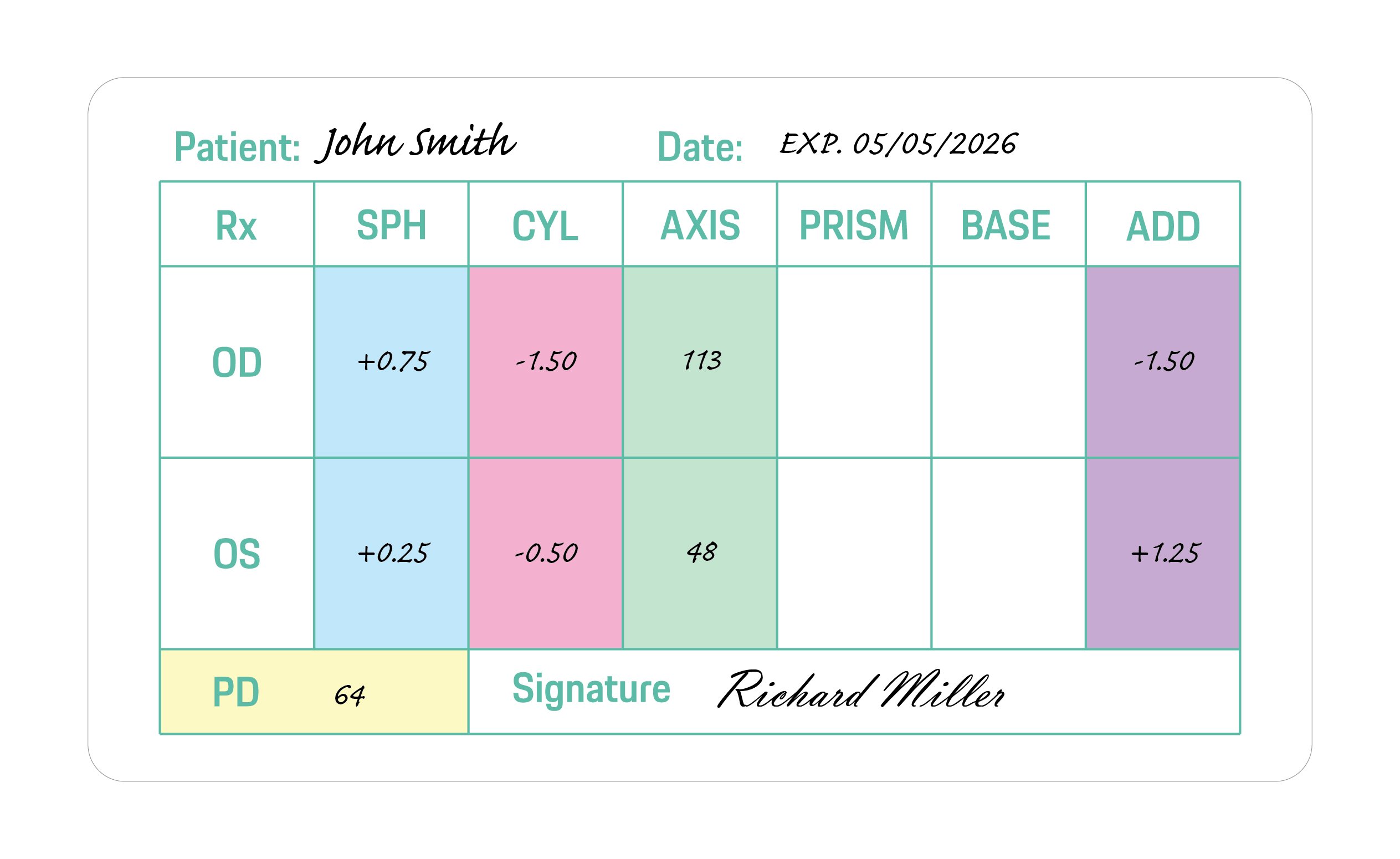
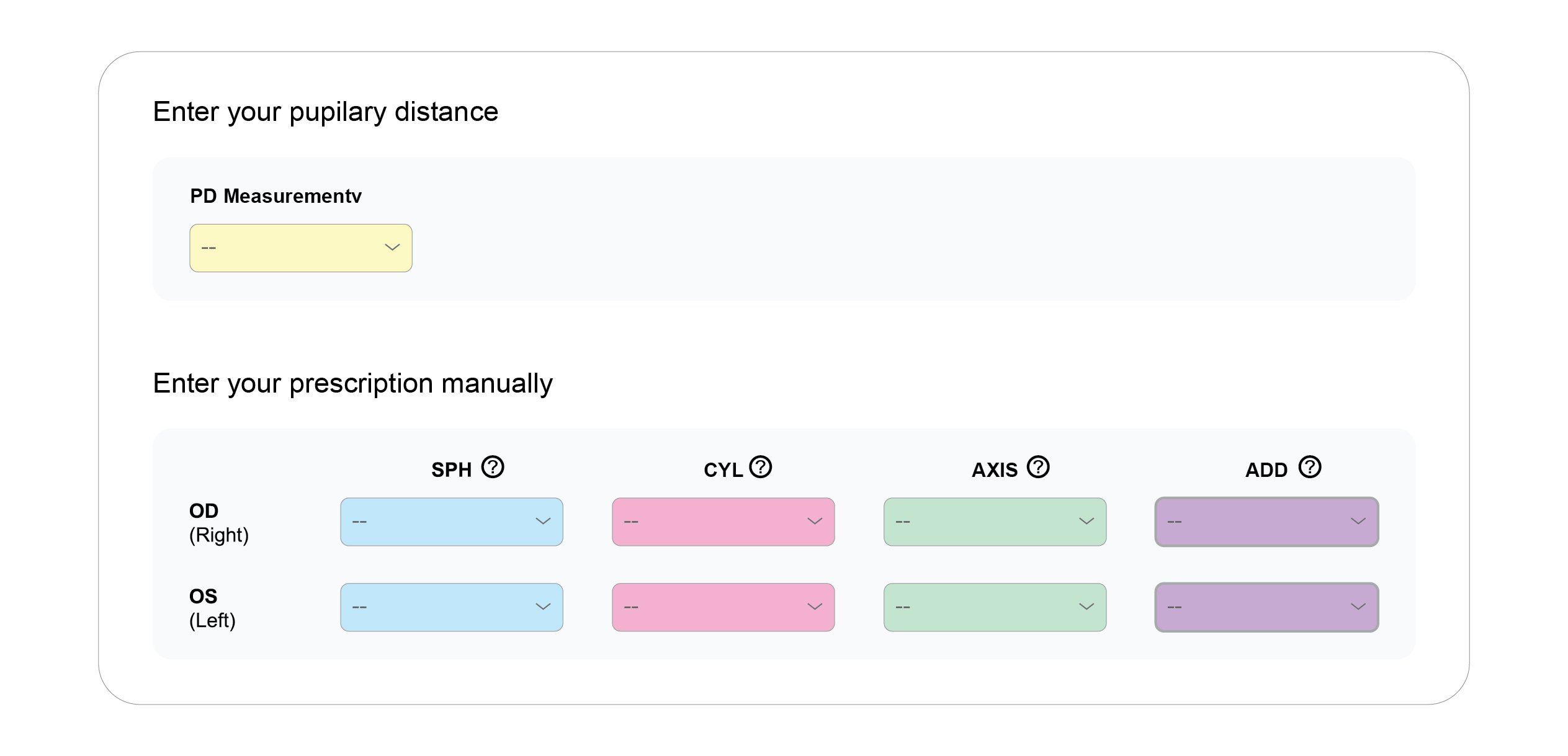
OD is an abbreviation for the Latin term oculus dexter which means right eye. Notice that the right eye information is asked for first even though we typically read from left to right.
OS is an abbreviation of the Latin oculus sinister which means left eye. That will be referenced on the far right column of the prescription.
SPH is short for sphere. The sphere of your prescription indicates the power on the lenses that is needed to see clearly. A plus (+) symbol indicates the eyeglass wearer is farsighted. A minus (-) symbol indicates that the eyeglass wearer is nearsighted.
CYL is short for cylinder. The cylinder indicates the lens power necessary to correct astigmatism. If the column has no value (is blank), it indicates that the eyeglass wearer does not have astigmatism. If this is the case on your prescription, you can leave it blank when entering it in.
AXIS is a prescription will include an axis value for those with astigmatism. This number represents the angle of the lens that shouldn't feature a cylinder power to help correct your astigmatism.
ADD is short for "additional correction." This is where details about bifocals, multifocal lenses or progressive lenses would appear.
In the world of creative photography and building, "Pose 1x2" isn't just a technical instruction—it's the secret to bringing a story to life. Whether you are arranging LEGO minifigures or directing a photoshoot, these helpful tips and stories illustrate how to master the art of the pose. The "Tiny Hero" Technique (LEGO & Model Posing)
: A "shy girl" on vacation wants photos that don't look forced. By stepping back and using a 2x zoom (which compresses the background) and a 1x2 natural lighting setup, the photographer can guide her through small, effortless movements.
When working with figures that have limited movement, the "Pose 1x2" concept often refers to utilizing a as a connector or anchor point to create dynamic action. Pose 1x2
Capture the "quiet moments" after the "smile and pose" shot. Character Design: Storytelling of Poses
: Imagine a LEGO Spider-Man perched on the edge of a skyscraper. Instead of standing him flat on a plate, builders use a 1x2 modified brick with a pin or axle to tilt the figure forward. In the world of creative photography and building,
: The most helpful "story" in a photoshoot is the narrative flow. Instead of one "perfect" shot, capture the in-between moments—slipping on shoes or walking away—to build a memory rather than just a snapshot. Essential Tips for Better Posing Application "If it bends, bend it" Minifigures & Models Even slight arm or leg movement adds life. Line of Action Character Illustration Gives the pose a clear direction and "rhythm". Natural Interaction Family/Kids Photos
For social media and vacation photos, "1x2" often appears as a shorthand for zoom and lighting settings (like ) used to capture natural-looking poses. By stepping back and using a 2x zoom
: This creates a "Line of Action"—a path the body follows to suggest movement even in a static object. By slightly separating the legs and angling the shoulders, you turn a plastic toy into a character in the middle of a daring rescue. The "Natural Vacationer" Strategy (Human Posing)
*Discount applied on the current website price at the time of order. Offer only valid for new customer first contacts order over $10. Maximum discount of $100. Cannot be combined with any other offers. Promotions are subject to change without notice. We reserve the right to cancel orders that are in breach of the terms and conditions of this offer.



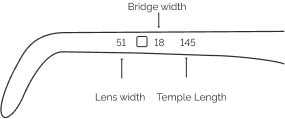
| Lens Width | Bridge Width | Temple Length | |
|---|---|---|---|
| XS | < 42 mm | < 16 mm | <=128 mm |
| S | 42 mm - 48 mm | 16 mm - 17 mm | 128 mm - 134 mm |
| M | 49 mm - 52 mm | 18 mm - 19 mm | 135 mm - 141 mm |
| L | >52 mm | >19 mm | >= 141 mm |
Buying eyewear should leave you happy and good-looking. Use our sizing tool to find frames that best fit your unique facial measurements.
Grab a regular card with a magnetic stripe on the back. Student IDs, credit cards and gift cards work well to start our online PD tool.
You may have received our paper PD measurement tool in your recent online order. In order to use this tool, place the ruler on your eyes so that the "0" lines up at the centre in between your eyes. Add up the two numbers, to get your PD. See example below:
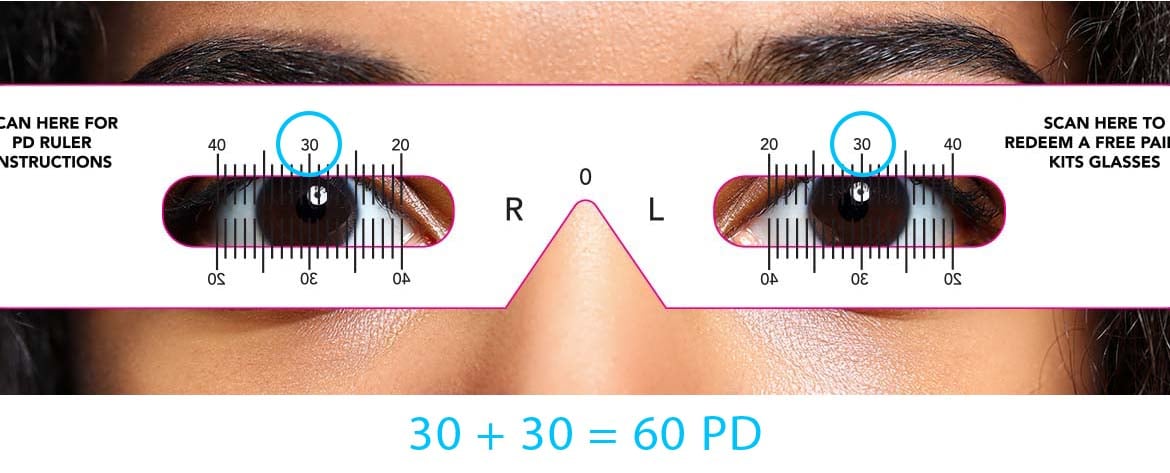
Click on this link to download and print your own PD measurement tool.
DOWNLOAD



 Check order status
 Place reorder
 Chat with us





 Use your insurance
 Help
Help